Puppy training · Edinburgh
Puppy Training in Edinburgh
The first few months of your puppy's life shape the dog they'll become. Kind, structured 1-2-1 training with Scott Blair — Crufts-winning trainer based in Edinburgh — to build the good habits that last a lifetime.
Why the first months matter
Get it right from the start
Puppies learn constantly, whether we are teaching them or not. The habits — good and bad — that form in those first months tend to stick, which is why early, thoughtful training is the single best investment you can make in your dog's future.
Family First Canine works with puppies from around eight weeks old, focusing on gentle foundations, positive socialisation and the everyday skills that make life with a young dog genuinely enjoyable.
What's covered
Everything your puppy needs
Socialisation
Confident, calm exposure to people, dogs, traffic, surfaces and everyday sights and sounds — done properly, so nothing scary sticks.
Stopping Puppy Biting
A clear, kind way to teach bite inhibition and appropriate mouth manners around adults and children.
Toilet Training
A simple, consistent routine that gets your puppy clean in the house quickly and without stress.
Early Recall
The foundations of a recall you can trust later — built from day one with reward, engagement and structure.
Lead Walking
Loose-lead walking from the very first walks, so pulling never becomes a habit in the first place.
Confidence-Building
Games and experiences that grow a resilient, settled puppy who copes with the world instead of reacting to it.
How it works
Tailored, one-to-one training
Every session is one-to-one and shaped around your puppy and your home. You are involved throughout — because a puppy that only listens to the trainer isn't much use to the family that lives with them.
We work in your home, in your garden, and out in the real world of Edinburgh's streets, parks and cafes — so the training holds up in the places you actually spend your time.
Why Scott
Crufts-winning, hands-on experience
Scott Blair is the founder of Family First Canine. His dogs have earned Best Puppy in Breed at Crufts 2020 and 1st Post Graduate Dog & Reserve CC at Crufts 2022, alongside a background in IGP and personal protection work. That depth of experience matters even for a young family pet — it means your puppy is being read, understood and taught by someone who has produced dogs at the very highest level.
More than credentials, the focus is on warmth, patience and consistency — the ingredients that turn a wriggly puppy into a wonderful family dog.
Areas covered
Edinburgh and the Lothians
Puppy training sessions are available across Edinburgh and the wider Lothians, including East Lothian, Midlothian and West Lothian. Get in touch to check your area — we cover most of the region.
Sleep and biting
The two things new owners ask about most
Almost every first call about a puppy involves biting, and almost every one of those is partly a sleep problem. A young puppy needs somewhere in the region of eighteen to twenty hours of sleep a day, and a puppy that is not getting it behaves exactly like an overtired toddler — frantic, mouthy, unable to settle and apparently deaf to everything you say. Owners often respond by adding more exercise and more stimulation, which makes it worse. Protecting sleep is frequently the single change that improves the most behaviour in the shortest time.
The biting itself is normal. Puppies explore and play with their mouths, and the goal is not to stop them using their mouth overnight but to teach them how much pressure is acceptable — bite inhibition — while redirecting the play onto something they are allowed to chew. That is a process of weeks rather than days, and it works far better than punishment, which tends to produce a puppy that is startled rather than one that has learned anything.
Socialisation
The window is open before the vaccinations finish
The most valuable weeks for socialisation arrive early, and they do not wait for the second vaccination. That leaves a genuine tension, and the usual resolution — keeping the puppy at home until it is fully covered — is the wrong one, because a puppy that has seen nothing in that period has a great deal of catching up to do and frequently never quite does. The answer is exposure without the risk: carrying the puppy out to watch the world go past, sitting somewhere busy at a distance, meeting healthy vaccinated dogs you know in your own garden, and getting the puppy used to traffic noise, buses, bins, umbrellas and the sound of children before any of it is close enough to matter.
Good socialisation is also not the same as meeting as many dogs as possible. What builds confidence is a series of calm, neutral experiences where nothing much happens — not a stream of over-excited greetings. A puppy that learns other dogs are simply part of the scenery grows into a dog that can walk past one. A puppy that learns every dog means an immediate play session grows into one that pulls and screams at the end of the lead when it cannot get there.
Toilet training and settling
Routine does the work
Toilet training is mostly a matter of frequency and consistency rather than technique. Take the puppy out often, after every sleep, every meal and every burst of play, go out with them rather than sending them, and reward the moment it happens outside rather than when they come back in. Accidents are inevitable and are not disobedience; cleaning them thoroughly matters more than reacting to them, and telling a puppy off after the event teaches it to go somewhere you are not watching.
Settling is the other half of the same job and it is taught, not waited for. A puppy that is never shown how to switch off learns that something is always about to happen. We build a place and a routine where nothing is expected of the puppy, practise short separations early so being alone is ordinary rather than alarming, and keep the evening calm enough that sleep is possible. Doing that from the beginning is considerably easier than treating separation anxiety once it has taken hold.
Further reading
Guides from the blog
If you are in the thick of it right now, the blog has a calm, step-by-step guide to stopping puppy biting, and one on loose-lead walking for the walks ahead.
Our dogs
Meet some of the dogs
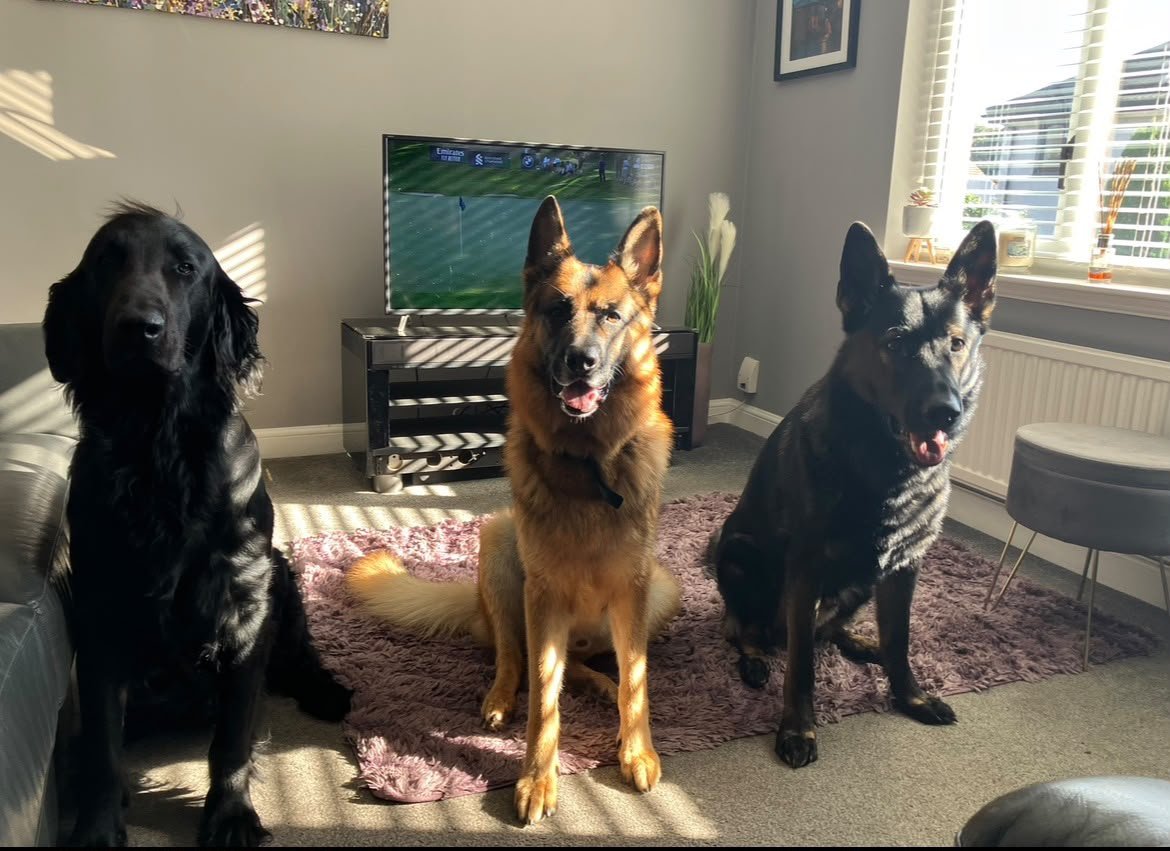
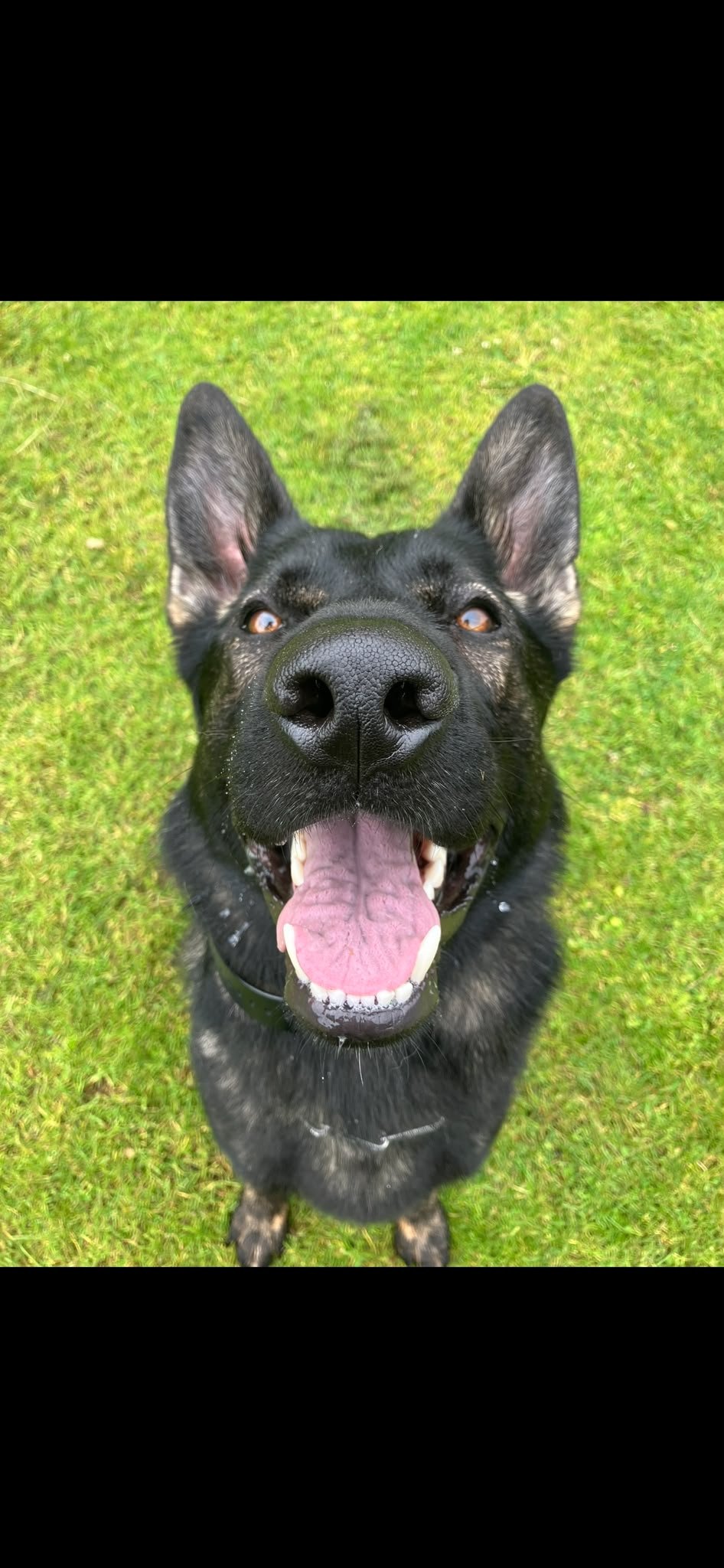
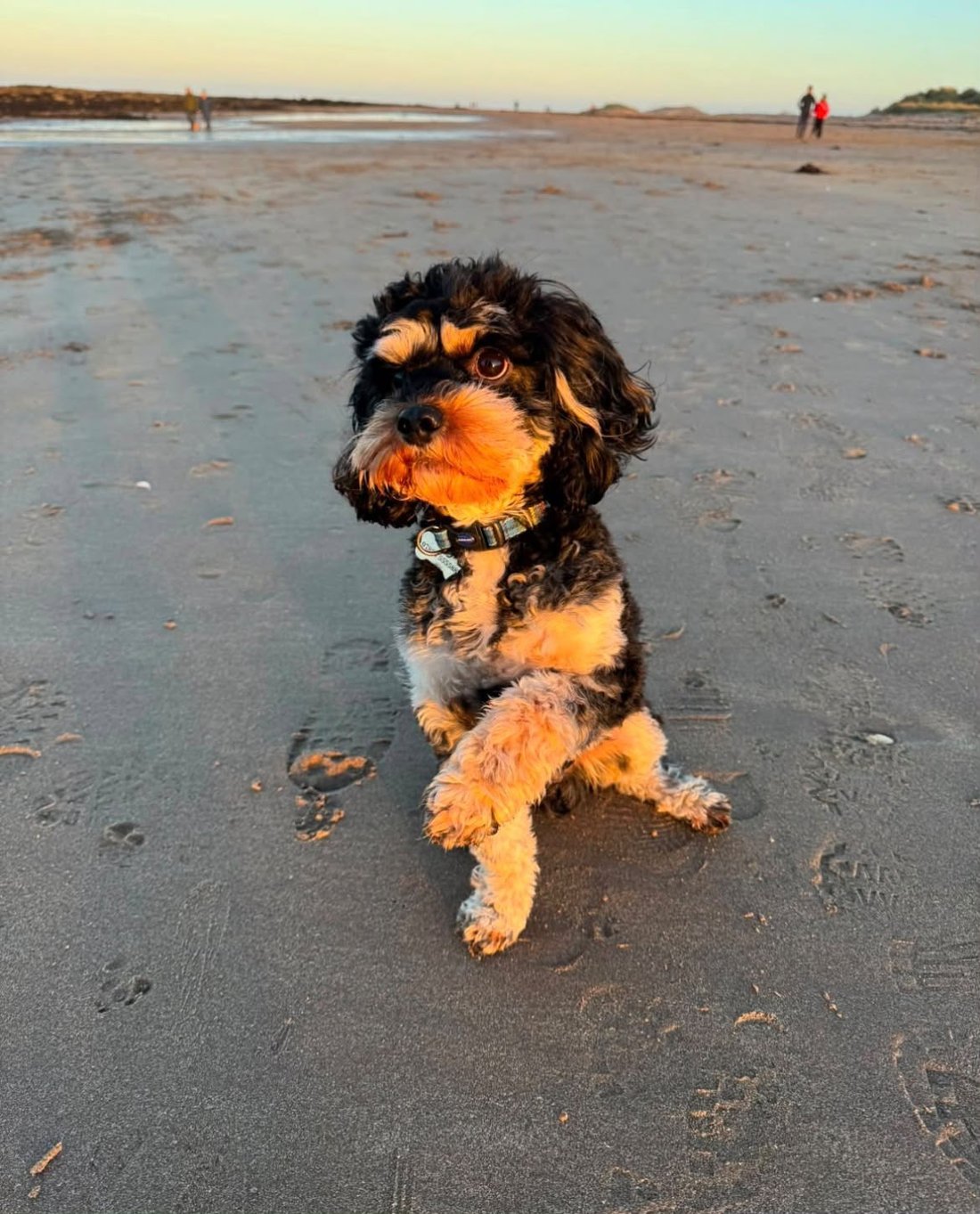
Common questions
Puppy training FAQs
When should I start training my puppy?+
As early as 8 weeks. The first few months are the most important window for socialisation and gentle foundations — the earlier you start, the easier every stage that follows becomes.
What does puppy training cover?+
Socialisation with people, dogs and the wider world, stopping puppy biting, toilet training, early recall, calm lead walking, and building genuine confidence in everyday situations.
Do you offer 1-2-1 or group puppy training?+
One-to-one, tailored to your puppy and your home. Every puppy is different, and progress is quicker when the training fits your family's life rather than a fixed class syllabus.
What areas do you cover?+
Edinburgh and the wider Lothians — including East Lothian, Midlothian and West Lothian. Sessions typically take place in and around your home and in real-world environments.
Can I socialise my puppy before the second vaccination?+
Yes, and you should — just not by putting them down on the ground everywhere. The socialisation window is open long before the vaccinations finish, so we use carrying, a safe garden, controlled meetings with healthy vaccinated dogs you know, and exposure to sound and movement from a distance. A puppy kept in a quiet house until it is fully covered has missed the most useful weeks it will ever get.
How long does toilet training usually take?+
Most puppies are reliable within a few weeks if the routine is consistent, though accidents at night can continue for longer because bladder control is physical as much as learned. The pattern that works is frequent trips out, going with the puppy rather than sending them, and rewarding outdoors immediately rather than after they come back in. Punishing an accident after the event teaches the puppy to hide where it goes, not to stop.
My puppy bites constantly — is that normal?+
Completely normal, and it is the single most common thing new owners call us about. Puppies explore with their mouths and they play with their mouths, and a tired or over-stimulated puppy bites harder. It is worked on by teaching bite inhibition rather than by suppressing the behaviour, and by fixing the overtiredness underneath most of the worst episodes.
How much sleep does a puppy actually need?+
Far more than most people expect — a young puppy needs somewhere around eighteen to twenty hours a day. A very large share of the behaviour that worries new owners, the frantic biting and the inability to settle in particular, is overtiredness rather than a training problem. Protecting sleep is often the first change we make.
Should I take my puppy to a group class instead?+
Classes suit some puppies well. But a puppy that is overwhelmed in a hall full of other puppies learns mostly that other dogs are overwhelming, which is the opposite of what socialisation is for. One-to-one lets the pace match your puppy, and the training happens in the house, street and park where you actually need it.
Ready to get started?
Get in touch with Scott to talk through your dog and how we can help. Based in Edinburgh, serving the Lothians and beyond.
Related services
Explore more of our training
Dog Obedience Training in Edinburgh
Lead walking, recall, settling and everyday manners — tailored 1-2-1 training for dogs of any age.
Learn more →Reactive & Aggressive Dog Training
Calm, structured 1-2-1 help for lunging, barking, lead reactivity and aggression toward dogs or people.
Learn more →Separation Anxiety Dog Training
One-to-one help for dogs who cannot cope with being left alone — howling, destruction at doors and pre-departure panic.
Learn more →Resource Guarding Dog Training
One-to-one help for dogs who growl or stiffen over food, toys, beds, the sofa or people — without punishing the warning.
Learn more →Family & Personal Protection Dogs
Stable, obedient protection dogs that are safe with your family — trained across Scotland.
Learn more →Dog Behaviourist in Edinburgh
One-to-one behaviour work for reactivity, aggression, anxiety, separation and resource guarding — the problems ordinary obedience training does not reach.
Learn more →Family Protection Dogs in Scotland
Train your own dog for family protection, or let Scott help you find and match a suitable, temperament-tested protection dog — across Scotland.
Learn more →Dog Training in Livingston & West Lothian
One-to-one training across Livingston, Linlithgow and the wider West Lothian area.
Learn more →Dog Training in Musselburgh & East Lothian
One-to-one training across Musselburgh, Dalkeith, Haddington and the wider East Lothian area.
Learn more →Dog Training in Dalkeith & Midlothian
One-to-one training across Dalkeith, Bonnyrigg, Penicuik, Loanhead and the wider Midlothian area.
Learn more →Dog Training in Leith, Edinburgh
One-to-one training across Leith, the Shore, Newhaven and the north of Edinburgh — built around flat living and busy streets.
Learn more →Dog Training in Portobello, Edinburgh
One-to-one training across Portobello, Joppa, Duddingston and the east of Edinburgh — from the beach and the promenade to flat living without a garden.
Learn more →Dog Training in Corstorphine, Edinburgh
One-to-one training across Corstorphine, Murrayfield, Clermiston and the west of Edinburgh — from busy St John's Road to the woods on Corstorphine Hill.
Learn more →Dog Training in Morningside, Edinburgh
One-to-one training across Morningside, Bruntsfield, Comiston and the south of Edinburgh: from recall in the Hermitage of Braid to settling calmly in a café.
Learn more →Dog Training in South Queensferry
One-to-one training across South Queensferry, Dalmeny and Kirkliston: from the narrow High Street and busy waterfront to recall on the Dalmeny shore path.
Learn more →Dog Training in Stockbridge, Edinburgh
One-to-one training across Stockbridge, Comely Bank, Inverleith and the New Town — built around flat living, busy pavements and the Water of Leith walkway.
Learn more →Dog Training in Newington & Marchmont, Edinburgh
One-to-one training across Newington, the Grange, Marchmont and the south-central city — from recall on The Meadows to settling in a tenement flat.
Learn more →Dog Training in Cramond & Barnton, Edinburgh
One-to-one training across Cramond, Barnton, Davidson's Mains and Silverknowes — from rock-solid recall on the foreshore to calm manners at home.
Learn more →Dog Training in Blackhall & Craigleith, Edinburgh
One-to-one training across Blackhall, Craigleith, Ravelston and the north-west of the city — from recall in the Corstorphine Hill woods to calm manners at home.
Learn more →Dog Training in Colinton & Juniper Green, Edinburgh
One-to-one training across Colinton, Juniper Green, Currie and Balerno — from recall in Colinton Dell to livestock-safe control on the Pentlands.
Learn more →Dog Training in Liberton & Gilmerton, Edinburgh
One-to-one training across Liberton, Gilmerton, Gracemount and Moredun — from calm lead walking on busy main roads to reliable recall in The Inch.
Learn more →Dog Training in Gorgie & Dalry, Edinburgh
One-to-one training across Gorgie, Dalry, Shandon and Slateford — built around tenement flat living, busy streets and the Union Canal towpath.
Learn more →Or head back to the Family First Canine homepage.
Get in touch
Let's get started
Ready to transform your dog and strengthen your bond? Reach out and we'll find the perfect programme for you and your family in Edinburgh or the wider Lothians.
5.0 — rated 5.0 from 16 Google reviewsContact details
Ready to book?
Use the form to tell us about your dog, or click below to go straight to the booking page. Based in Edinburgh, Scotland.